Tuesday, April 8, 2014

Pavement, Dirt, Pavement, Repeat

Any time I hear the words dual-purpose, dual-sport or hybrid I become skeptical since in most cases they represent compromise.  In my mind a piece of equipment that is a compromise means it probably does not do anything well.  A good mountain bike turned into a road bike is now a heavy road bike and a poor mountain bike.  It is probably not a lot of fun to ride on either surface.  Of course, there will be limitations between combinations, but they do not have to be a compromise in my opinion. 
 

My project to use one bike for over 90% of the  of my riding this year means that I am looking for that no compromise ride.  It is with that goal in mind that I built-up the MOOTS CX bike this fall and have tried various tire experiments.  To summarize, the bike and components work very well on spirited road and group rides, commuting, riding in snow and ice, and dirt/gravel roads with the right tire choices. 


This is all fine and good if you do not mind swapping tires all the time, but I am lazy so I have been searching for that no compromise tire which works very well for road, commuting and dirt/gravel. The criteria for this tire are fairly rigorous in that it must be tubeless, supple, durable, comfortable on all surfaces (with varied pressure) good handling and under 300g in weight.  My research has led me to try the relatively new Hutchinson Sector 28  tubeless tires and determine whether they are suitable as a true dual-purpose tire and without compromise.

I have over 700 miles on the Hutchinsons and they have proven themselves as an excellent road tire - period.  I have settled on 65 psi for purely road riding and have begun experimenting (with the highly scientific Goldilocks method) with various pressures off-road and exploring the limits of what feels best for my riding preferences and 200 pound build with the following thoughts:

Elder Road with moisture keeps the dust down while improving traction
 80/80 PSI F/R: Too hard! Good on the pavement with excellent flat protection and grip, but not as comfy as I had hoped.


70/70 PSI F/R: Pretty much the same as 80 PSI, but slightly more comfy.

Summer roads typically do not have gravel and get very soft and rutted during winter and spring

40/40 PSI F/R: Too soft! Decent on the pavement but slightly mushy with excellent flat protection, comfy with good traction off-pavement but prone to bottoming-out on rocks or washboards.


Tires hooked-up well even in the soft stuff but would not work if it was much wetter

65/65 PSI F/R: Just-right!  Perfect for pavement being supple, comfortable, low perceived rolling resistance without being mushy out of the saddle or folding-over in turns. Not as comfy off-pavement, bouncy on rocks and washboards, while not inspiring confidence in turns.


The sticky stuff only attaches to the diamond tread on the sides
 45/50 PSI F/R: Just-right!  Good on pavement being supple, comfortable, low perceived rolling resistance without being too mushy. Very comfy off-road, supple on rocks and washboards, and inspiring confidence in turns without bottoming-out (much).

Note the absence of tread in the soft stuff.  This means keep the butt in the saddle on steep climbs unless you have momentum
For me, the 45/50 combination was the best all-round performance if I know I am going to ride on/off pavement in the same ride or if I am strictly off/pavement.  If I am on pavement only, then 65/65 is preferred.

I checked the tires for nicks, cuts or abrasion but have not observed any damage after about 40 miles of off-pavement riding.

Am I ready to declare the Hutchinson Sector 28 Tubeless tires THE no compromise tire for on/off pavement?  Stay-tuned.

Two Wheel Transit - Cycling for Life

Monday, April 7, 2014

In the Desert - Days 5 and 6


Day 5
Recovering the prior day with a pretty leisurely 51 miles made a difference in riding 60 miles today.  It began to sink in that I would be traveling back home in two more days to wet and cool spring days in the northwest.  I knew I would miss seeing the White Tank Mountains at sunrise each ride and that it would be a few weeks before I was riding in shorts and a jersey absent several layers again.

Today, I did not feel like hammering along in the saddle for 3 hours so I warmed-up until I found a 2 mile section of a slight uphill grade and did max effort sprints until I was out of gas.  Hill repeats are different here because they are less steep than the northwest so I do not cool-down as badly on the recovery.  The other cool thing about the Sun Valley Parkway is that there is a U-turn lane about every mile or so which makes it easy to do multiple laps once you find a suitable section.

In this case each lap was 4 miles so 5 laps was enough and then time to head back to the ranch.

Day 6
My last day of riding in sunny AZ in conditions I most likely wont see at home until June or July so I made the most of it with a 60 mile ride at max sustainable effort.  I learned a few years ago that I can ride for hours in the bottom to middle of Zone 4 as long as I keep the fluids and calories going during the ride - effectively my max sustainable effort.

The other thing I learned was that just because I am burning 900 calories per hour at this level of work, I do not need to replace (nor should I) more than 250 to 300 of those calories per hour on the bike.  In other words, I was eating too much on the bike and would overload my system and cause it to shut down on long rides resulting in dehydration, bloating, cramping and bonking.  Optimally, I should drink one large bottle and take two gel packs each hour. 

My ultimate test of this system was the 2012 Ride Around the Pioneers in One Day (RATPOD) where I completed the 130 mile ride with 6,000 feet of climbing, heat and horrendous headwinds.  The only solid food I had all day was a couple slices of bread, half a bagel, 4 fig Newtons and half a cookie.  Using the 1 bottle of water and 2 gel packs an hour rule had me feeling as good as could be expected at the end of a grueling ride, but I digress.

I felt well enough to crank-out the 60.1 miles in 3 hours for a glorious end to 6 days of spring riding camp.


Days: 6
Total Miles: 350

Does riding a week in warmer, drier and flatter conditions make for a better cycling season?  I do not know, but it certainly felt nice to ride in the sun and be warm again after winter.


What I do know is even though the MOOTS is a CX bike, I had a great time riding it on the road and was incredibly comfortable the entire time.  I also know that the Hutchinson Sector 28 tires performed very well with no flats and a supple ride at 65 psi the entire time.  After 425 miles I am really starting to be impressed with these tires - they are THAT good.


The real test will be getting them out on some gravel roads at varying pressures to see how they handle and whether they are durable enough to handle the sharp Spokane County basalt. 


Obligatory Selfie at 23 MPH

As noted above, I do not know whether this trip will make much difference in my fitness level this season, but mentally it made all the difference in the world.  My work schedule for the past 18 months has been probably the most intense of my professional career without much break.

Being able to hang with my folks, ride in the sunshine for hours on uninterrupted asphalt and let my mind go where it wanted is a good start to getting some perspective.  Perhaps this should be an annual trek each winter though with my family in the future.  I knew it was time to head for home when I began to tire of the same stark landscape and the same stretch of road and miss my wife and kids.

Next up is getting back to some gravel riding in the northwest and reporting on the 2,000 mile mark on the MOOTS.  Thanks for reading.

Two Wheel Transit - Cycling for Life

Saturday, April 5, 2014

In the Desert - Day 3 & 4


Having learned the route and survived the menacing golf carts I felt pretty confident on Day 3 of spring training camp in Phoenix, AZ. Training camp was about to turn into boot camp - I just did not know it yet.

I got an earlier start, with temps in the 50s making me feel more at home and ready for anything.  Warm-up out to the White Tank Mountains felt good and then rolling out past Buckeye was one of my best mornings. 


I felt strong and fast at the 20 mile mark which is where I should have turned-around. I had a slight tailwind and a big headwind brewing.  Today, I wanted to see where the road intersected I-10 to the south (don't ask me why).

After my usual turn spot the road got rougher and less scenic but onward I rode.  I hit I-10 almost right at 35 miles - so flip a U-turn and spin back to the folk's place in Surprise - sounds easy.  No such doing.  The heat was rising quickly, and the wind began to howl.  Next 30 miles were brutal of slow, just grind-it-out pedaling.

I stopped at the convenience store to replenish my depleted water supply a few miles from home and asked the clerk about the wind.  "is the wind always like this?" I asked, the old fellow thought for a bit and replied "oh no, it is not - most times its worse" and had a hearty chuckle at my expense.

I rolled-out and endured the last 15 miles  of heat and headwind home totaling a 4 hour ride and 70 miles.

Day 4 - Avoid mistakes and do a little recovery - 51 miles out and back at tempo pace.  No snakes, witty store clerks or gale force winds.  Just tempo pace for the whole ride.

Total miles: 241


The next installment will cover my final 2 days of spring training camp and some thoughts about equipment and riding in the southwest.

Two Wheel Transit - Cycling for Life


Tuesday, March 18, 2014

In the Desert - Days 1 and 2


Day 1 in the desert broke with some high clouds, light wind and moderate temperatures.  The Moots had been assembled the afternoon before and was ready for a shake-down ride.  I had planned on starting out around 7 am for a tempo pace ride and some time in the saddle.  Somehow after getting provisioned, dressed and out the door was delayed until 8:30 with temps solidly in the mid 60's.  So much for good planning.
 
The route was selected to get me out of town and away from golf carts (driven on the road and not necessarily related to the act of golf) which appear to be more prolific than cars and certainly driven as poorly or worse in most cases.  If I ever hear a motorist in Spokane complain about cyclists again I will encourage them to take a trip down to the burbs of Phoenix and enjoy the golf carts whizzing around piloted by seniors (queue the Benny Hill music,)
 
Sun Valley Parkway runs from Surprise, AZ through Buckeye and down to I-10 about 35 miles later.
The out-and-back route was perfect with light traffic and ample (12 foot) designated bike lanes the entire way. Locally, this lane would just be a nice wide shoulder and not designated as a bike lane which was cool, but I am not sure what the advantage was since a shoulder works just the same. Curiously, there are no bike lanes that I have found in the populated, incorporated areas which seems to be where they are needed.  Perhaps this is purposely since they would most likely be filled with golf carts driving in random directions resulting in foreseeable collisions and altercations.
 
It is almost desert-flat and any grades are very gradual.  I did not know how far I would end-up riding since the effect of the "heat" was unknown at that point.  The other advantage of the route is that there is a 55+ residential development called Sun City Festival which is touted as an "Active Adults 55 and Over Community."  The community has a great mini-mart to restock on water on the ride.  You would think that as active as the community is supposed to be a person could find a Clif Bar or something, but none were to be found.
 
Is one of these peeps a photo bomber?
You are assaulted with billboards showing people being active.  The most activity I witnessed was the frenzy to purchase Sunday papers for the TV guide (I am not making this-up) and restock on Bud Light. 
 
The ride itself was a 60 miler out and back with amazing vistas and desert scenery.  Getting a late start and not being acclimated to the arid air and warmer temps meant that I went through a lot more water than I would normally.   I also was overly exuberant given the temps heading toward the mid 80s but was just so happy to be out riding in the sun.  I must have looked particularly dehydrated or bucking a headwind because 6 huge vultures were circling over me at one point.
 
One of the most interesting parts of the ride was the discovery of a Mohave Rattlesnake (Crotalus scutulatus) in the eastbound bike lane.  It was a beautiful specimen of about 3 1/2 feet long and almost as big around as my wrist.  He seemed a little oddly positioned and was not serenading me with his 6 button rattle when I stopped for a visit.


The dark areas on the pavement are from my attempts to elicit a response with the strategic use of a water bottle stream from a seemingly safe distance.  Alas, I was too late and it had succumbed to a non-apparent mortal injury or was really good at playing possum.  He appeared to have been freshly or mostly dead and I had to wonder if another cyclist had run him over since it was apparent that a car had not. 
 
Regardless of his state, I imagined many interesting cycling scenarios where a pace line or otherwise unobservant cyclist would come upon one of these in the bike lane and the mayhem that would ensue (queue the Benny Hill music.)
 
Day 2 broke clear with some high clouds (is anyone sensing a pattern) and I got an early start with while the temps were in the high 50s.  The early start and better hydration and nutrition preparation atoned for my previous day's mistakes and made for an enjoyable 60 miler at 20 mph average speed.  I was more comfortable with my environment and spent more time enjoying at the surrounding mountains and terrain than the prior day trying not to die and outrun the vultures.  I looked for the prior day's snake but he was gone which left me to imagine many other scenarios including that he was just playing possum when we last visited.

The next installment will include Days 3 and 4 along with further exploration, wildlife encounters and some thoughts on the Moots Psychlo X as an all-round bicycle - until then.

Two Wheel Transit Bicycles - Cycling for Life.

Monday, March 17, 2014

In the Desert You Can Remember Your Name


I have only taken one riding vacation since I began cycling seriously in 2006. During spring break 2009 I rented a Trek Madone in west Florida and jumpstarted my fitness and base miles that year.  That was also the same year I had set a goal of riding the STP in one day and needed all the fitness and miles I could get.

Once I achieved the age of 40, the days of hitting the road for 2 weeks each spring to get back in shape were long gone and it became a year-round endeavor.  Even so, there is something to said for stressing the body with several days of 40 or 50 plus miles in a row at tempo to interval pace.  I consider it training to train since the intensity can be just that much higher after a 5 or 6 day session, but apparently I am not made of stuff that allows me to do that in rain, wind and snow.

I cannot state scientifically whether my spring training was the difference that year, but I did meet my goal of completing the 202 mile ride in one day so something worked.  I have no such ambitions this year, but want to be fit, healthy and reasonably fast on the bike for 2014.

Being in ownership of a bike shop means that part of my job is to go to other bike shops to look for new trends in the industry, explore new merchandising and discuss the business aspect with other owners - all in the quest to continually improve the customer experience at Two Wheel Transit.  As you might imagine the cycling industry is fairly competitive so staying up-to-date is a must. Bike shop owners are more at liberty to discuss the business details of their shop when you do not compete in the same geographic region.

With this in mind I planned a trip to the Phoenix, AZ area and just happened to bring a bike along for the trip. (I suffer for my work) I checked around and chose Southwest Airlines to move the Moots and me after considering ticket prices, schedule and bike luggage fees.  Southwest is still rated among the friendlier skies for bikes (just behind Frontier) and charges $75 each way for your beloved steed due to oversize status of a bike box.

I used a cardboard bike box and packed some other things like shoes, CO2 water bottles, CamelBak pack and tools. I also had the bike expertly packed by our shop to minimize the chance for mishap on the way down,


The TSA either wanted to get a close-up look at the amazing Moots or suspected I was smuggling contraband.  Regardless of reason, they opened the box for closer inspection and relieved me of my favorite 25g CO2 cartridge.  Remember that they are prohibited on flights in luggage of any kind, but guess I forgot.


Though not thrilled about paying to have a 29 pound piece of luggage checked, I must say that the bicycle and box arrived in pristine condition. The box was both taken from me and delivered to me by a representative from the airline so there was some special handling involved. The option of renting a current model TREK Madone or Domane in a known size and fit configuration would probably be a wash when you consider the boxing, hassle and transportation costs of bringing your own bike, but I wanted some more bonding with the Moots and tubeless tires so it got the nod in this case.

Mr. Moots - meet Arizona
There is some incredible road, mountain and gravel riding in this area but for me it is about getting-out without 30 minutes of layering, seeing that yellow thing in the sky again and stressing the bod to make it stronger without breaking it. 

Since I have already profiled one of the bike shops I visited, the next few posts will include some riding, routing and observations so stay tuned.

Two Wheel Transit - Cycling for Life

Sunday, March 16, 2014

Trek Bicycle Store West - Phoenix, AZ


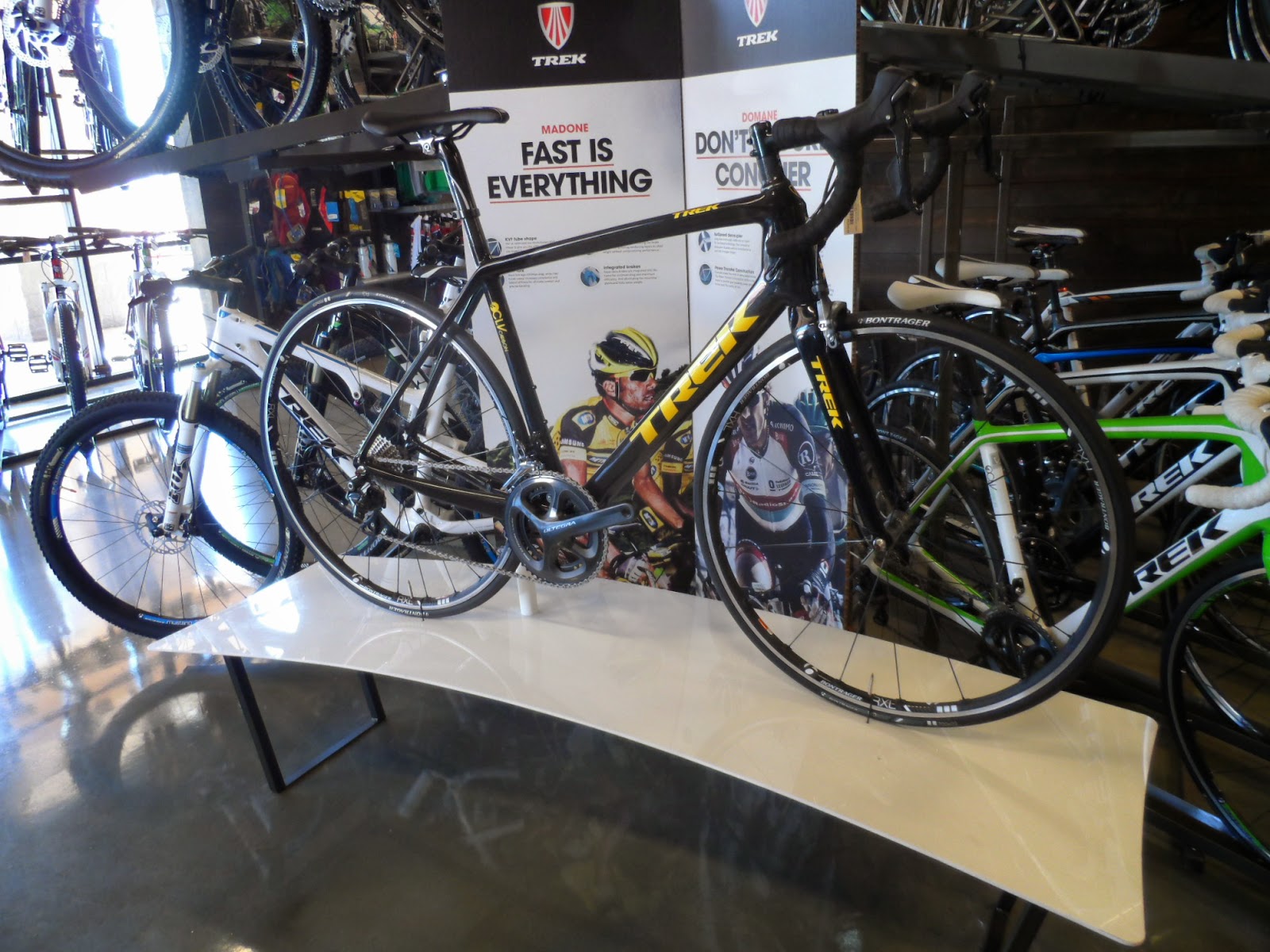
On a recent trip to Phoenix, AZ (more on that later) I stopped-in to meet the guys at Trek Bicycle Store West. The store is now about 3 years old and still looks brand new with a clean and open floor plan and great use of color to make it feel larger than it actually is.

Shop Talk
 
Project One Focus Area
I was envious of the floor to ceiling glass on 3 sides of the store.


The guys on duty today were very approachable and an clearly very proud of a great store.  They also are very knowledgeable and passionate about the local cycling scene and their products. 


I enjoyed talking shop with them and getting to see another shop's approach to merchandising, layout, technical area and sales.  The foot traffic was brisk but they handled everyone with ease.


If you are ever in the area and need parts, accessories or service these are the go-to guys. 

Monday, March 10, 2014

Size Matters


Exactly a year ago to the day, I stirred conversation in the local cycling scene by stating "tire tread is not critical and riding road tires on reasonably compact dirt and rock should be fine otherwise" in Sammy or David Lee? Despite my exhaustive, non-scientific research at that time on exactly 5 miles of dirt road, some still contend you need deeper tread patterns on dirt roads vs paved roads.  This discussion is all fine and good, but if you REALLY want to get people worked-up start a conversation on the relative merits of different tire widths.

My second observation during that research had more to do with tire size as opposed to tread and I surmised that I would consider running more volume like a 25 or 28 if riding a route that had a lot of dirt.  Running tubes in low volume tires requires pressure near or at the maximum rating for the tire to avoid pinch flats.  That means the tire simply bounces off of any rocks or bumps rather than flex and conform - it makes the ride rougher, slower and less safe since even the best tires in the world have zero traction and control whilst in the air.

Since those original 5 miles I have ridden on a lot more dirt and rocks using 25mm road tires, 32 mm CX tires and 35mm studded snow tires - all but the 32mm CX tires have been with tubes.

One thought that has occurred to me as I have more experience off pavement is related to the intended riding surface and tire size/volume.  I am beginning to believe that up to a certain point, running higher volume tires has benefits on both dirt and pavement as opposed to just dirt.  After about 25mm the incremental benefits of wider tires on the pavement all but disappear, but increase off-pavement.

Bicycle Quarterly has published some findings from their more scientific research on rolling resistance of different tire widths which can be found on their blog Off The Beaten Path.  Their findings in general state that there is statistically no difference in rolling resistance in tires 21 - 31mm on very smooth surfaces, but wider tires roll with less resistance on moderately rough road surface.

What is most significant in the difference in tire widths is not contact patch at relative inflations, but volume.  While width increases by 6mm (24%) between a 25 and 31mm tire, the volume increases by 54% which means you can run lower pressure both with and without tubes.  Tubeless you can go even lower since you cannot get a pinch flat.  Lower pressure means more comfort and safety with reduced rolling resistance off-pavement. 

So, if you can increase tire width with no adverse effects on pavement but gain benefits off-pavement, why would you not choose this if you want to ride both without switching tires?  Weight, frame clearance, tire selection are all possible reasons not to run wider tires.

If I was going to ride nothing but dirt with the Moots I would run 34mm CX tubeless tires.  If I was only going ride road, I would ride 25mm road tubeless tires.  But I want to ride both on the same ride without feeling like I am giving-up performance on either surface (not asking for much, really).

After some research I chose the Hutchinson Sector 28 700x28 tires for the first round of a dual purpose, no compromise rubber.  At this point there are not any choices for a tubeless road/brevet tire larger that a 28.

 
I looks like a pretty typical road tire and mounts nicely to the Easton EA 90 wheels. You will also notice that it does not have much in the tread department so I will continue testing my theory that tread is not super critical in most off-pavement conditions. It must be the clearance on the Moots, but the tires look more like 25s than 28s though the measurements say otherwise. 


It appears that most 200 pounders opt for somewhere close to 70 psi for the road and I selected 68 psi for my first road ride.  It turned-out to be a 75+ mile ride of mostly chip seal on which I became very acquainted with the Sectors.  My first impression are:  good traction, comfortable ride, stable cornering and reasonably light without tubes.
 
The tires felt great, but I dropped them down to 65 psi for my second ride of you guessed-it, chip seal.  That seemed to be the ticket offering good compliance without being squishy or unstable in hard cornering. 
 
 
I plan on dropping the pressure a bit more for some gravel riding and will report back on the overall experience on and off pavement.  For now I am loving it.  Someone asked me on the first ride whether I felt any sluggishness and the answer was "no" as the average speed for the longer ride ended-up well over 18mph.


So far I have had a road, cross, gravel and snow configuration on this bike. I am not sure what to call this setup since I suspect that it will work under many conditions.  I will report back after some more extensive, non-scientific research.


Two Wheel Transit - Cycling for Life